

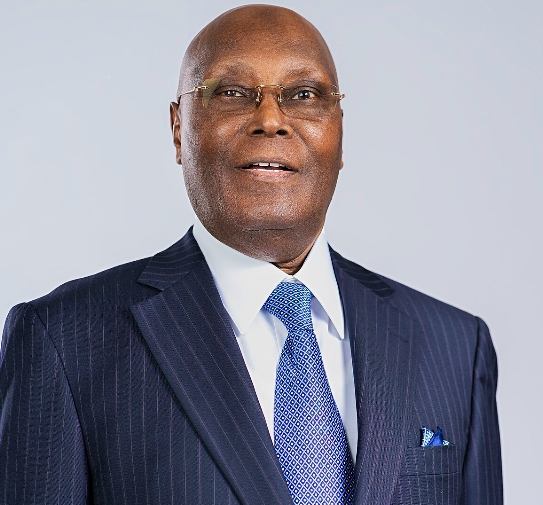
You probably have known or have read that Atiku Abubakar was born on 25 November 1946 in Jada, a village that was then under the administration of the British Cameroons – the territory which later joined the Federation of Nigeria in the 1961 British Cameroons plebiscite. You also may have known that his father, Garba Abubakar, was a Fulani trader and farmer, and his mother was Aisha Kande. Moreover, he was named after his paternal grandfather, Atiku Abdulqadir, who hailed from Wurno, Sokoto State, and migrated to Kojoli village in Jada, Adamawa State.
But what you probably did not know is that Atiku Abubakar would have ended up a dropout and a common man on the street without formal education but not for government intervention as his father was strongly opposed to the idea of Western education and tried to keep Atiku Abubakar out of the traditional school system. Atiku did not only enrol in primary school but also proceeded to secondary school alongside 59 other students graduating in 1965. He today can boast of not just a university degree but also a master’s degree in international relations at Anglia Ruskin University, Cambridge, United Kingdom.
This near miss would later propel him to award thousands of scholarships to indigent/brilliant students up to university level, having himself understood the importance of education and the negative effect of the lack of it. The turning point of his love for the golden fleece was his establishment of the American University of Nigeria in his home state of Adamawa to bring the American style of education nearer home. And again, you probably didn’t know that he has ceded the institution to the community as his selfless contribution to the advancement of tertiary education amongst his people. What this means is that no revenues from the institution go to Atiku’s account. Instead, he invests lots of money into a dedicated scholarship programme at the American University of Nigeria, thus making him one of the few blessed Nigerians to do so.
Only a few have also known the man Atiku Abubakar to be a successful businessman. His foray into business was and is not mistaken, for as local parlance says, “the kid (little goat) would most often follow the footsteps of its mother.” Realizing how successful his father had been business-wise, Atiku naturally stepped into those shoes and did not regret that decision.
Over the years, Atiku has ventured into trading, buying, and selling truckloads of rice, flour, sugar, agriculture as well as real estate. His other business interests located within Yola, Adamawa include Adama Beverages Limited, a beverage manufacturing plant in Yola, an animal feed factory, among others. But his most outstanding business move probably came while he was a Customs Officer at the Apapa Ports during which time an Italian businessman in Nigeria, Gabrielle Volpi encouraged him to set up a logistics company operating within the Ports, the Nigeria Container Services (NICOTES), which later became Intels Nigeria Limited and provided immense wealth to not just Abubakar but also providing gainful employment opportunities to many citizens, thus taking them off the vastly saturated Labour market. And although the Federal Government, especially under Buhari had tried to cripple his business empire, Atiku had remained resilient and is no doubt one of the leading private employers of Labour, helping to ease Nigeria’s economic hardship.
Politically speaking, Atiku Abubakar stands tall as only one of the very few politicians who have a living conscience, a high level of dignity, honour, and unparalleled sincerity For instance, during the Third Term debacle, Atiku vehemently
rejected all entreaties from the top echelon of governance to back the move, citing the Constitution, which forbade such. For him, having been sworn in first on 29 May 1999, as Vice President of Nigeria and again in 2003 was a feat they (the politicians) ought to appreciate God and Nigerians for. And so pursuing a Third Term agenda amounted to pushing their luck too far with dire consequences.
His rejection led to a frosty relationship as he fell out with his boss, Olusegun Obasanjo. Little wonder in 2006, Abubakar was involved in a bitter public battle with his boss, President Olusegun Obasanjo, ostensibly arising from the latter’s bid to amend certain provisions of the constitution to take another shot at the presidency. Dissatisfied with the goings-on at the time, he left the Peoples Democratic Party (PDP), the platform on which he rode to power, to the Action Congress of Nigeria (ACN) in preparation for the 2007 elections.
In a November 2013 interview regarding Obasanjo’s alleged attempts to justify his third term bid, Abubakar is quoted as saying: “[He] informed me that ‘I left power twenty years ago, I left Mubarak in office, I left Mugabe in office, I left Eyadema in office, I left Umar Bongo, and even Paul Biya and I came back, and they are still in power; and I just did eight years, and you are asking me to go; why?’ And I responded to him by telling him that Nigeria is not Libya, not Egypt, not Cameroun, and not Togo; I said you must leave, even if it means both of us to lose out, but you cannot stay.” What a man!
As often said, a Golden Fish has no hiding place and according to the Holy Book, “You do not light a lamp and hide under a cover”, so a man as selfless as Atiku needs to be recognized and honoured. And so in 1982, Abubakar was given the chieftaincy title of the Turaki Adamawa by his future father-in-law, Lamido Adamawa, the paramount ruler of Fombina Emirate in Adamawa State, Alhaji Aliyu Mustafa. The title had previously been reserved for the monarch’s favourite prince in the palace, as the holder is in charge of the monarch’s domestic affairs. In June 2017, Abubakar was given the chieftaincy title of the Waziri of Adamawa, and his previous title of Turaki was transferred to his son Aliyu.
Atiku Abubakar’s philanthropic disposition transcends the global stage. For instance, his donation of over 750,000 to the National Peace Corps Association in the United States “to fund a new initiative featuring global leaders who will discuss Peace Corps’s impact has remained the largest ever individual donation in the Association’s history. This gesture did not go unnoticed. And so, while celebrating the 50th anniversary of the US Peace Corps in 2011, the National Peace Corps Association (NPCA) – an independent Non-profit Organization separate from the Peace Corps that serves as an alumni association for Returned Peace Corps Volunteers – honoured Abubakar with the Harris Wofford Global Citizen Award. At the presentation of the award. The National Peace Corps Association described Abubakar as one individual who contributed to the development of higher education on the continent of Africa. “No private businessman in Africa has worked harder for democracy or contributed more to the progress of higher education than Atiku Abubakar,” the NPCA had said at that occasion.
The man Atiku Abubakar is a God-fearing man, a philanthropist of no mean repute, an astute politician, a businessman, a caring father of his children, and a defender of our democracy, the poor and vulnerable. His rating in the political/business world is unmatched as he has continued to bring out dynamic ideas and innovations too lofty to ignore.
That, indeed, is the hidden truth about the man Atiku Abubakar, GCON, the Waziri Adamawa.
Chief. A.E Onwuka.
20/11/24