

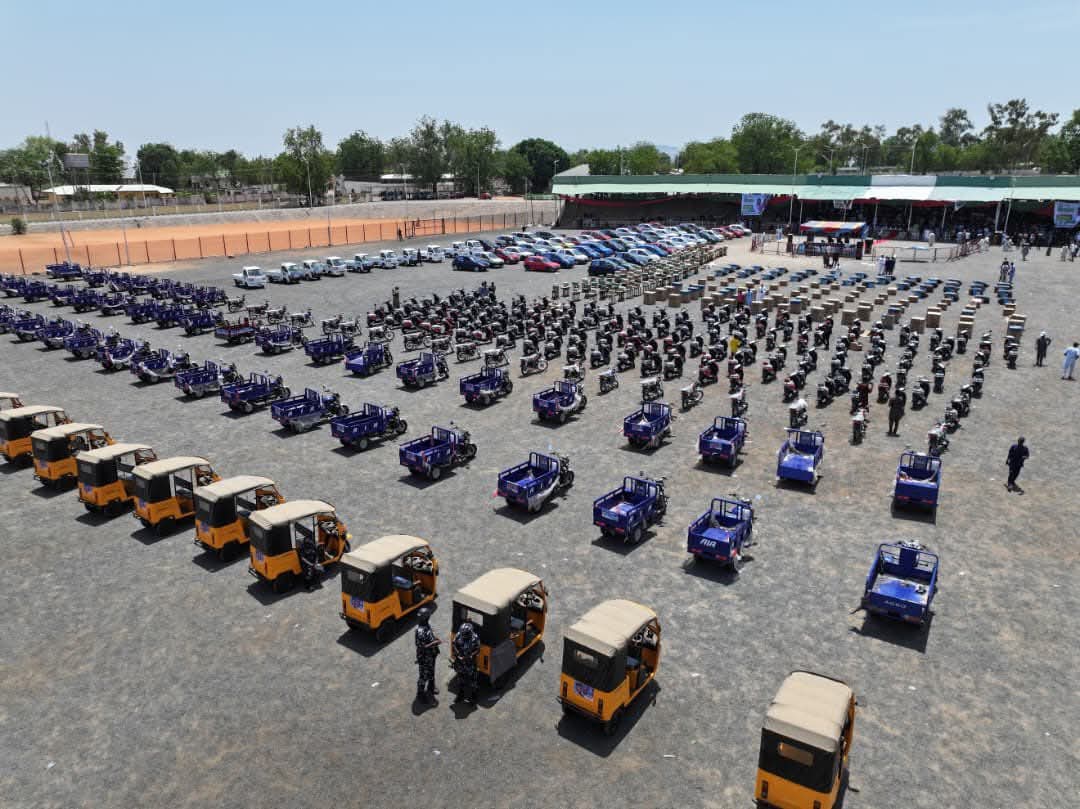
On a sunlit Saturday in Yola, the expansive grounds of Mahmoud Ribadu Square transformed into more than just an event venue it became a marketplace of hope, ambition, and new beginnings. Hundreds gathered, not merely to witness another political gathering, but to take part in what many described as a life-changing moment.
At the centre of it all was Senator Aminu Iya Abbas, whose large-scale empowerment programme is now being talked about as a defining intervention in grassroots development across Adamawa Central.
But beyond the impressive numbers—60 cars, 170 motorcycles, 100 tricycles, 100 sewing machines, 50 generators, refrigerators, and solar-powered water pumps—the real story lies in the faces of the beneficiaries and the possibilities now within their reach.
A Shift from Aid to Opportunity
For years, empowerment programmes have often been criticized as symbolic gestures. Yet, this initiative signals a deliberate shift—from short-term assistance to long-term economic participation.
Standing before a crowd filled with traders, farmers, artisans, and transport operators, Senator Abbas framed the intervention not as charity, but as a catalyst for independence.

“My mandate is a sacred trust,” he said, his voice steady but deliberate. “This is about giving our people the tools to build, to grow, and to sustain themselves.”
His message resonated deeply in a region where access to capital remains one of the biggest barriers to economic mobility.
Stories Behind the Statistics
Among the crowd was Shamsudden Bello, a transport worker who had spent years renting motorcycles to make ends meet. For him, receiving a tricycle marked a turning point.
“What I earned before was barely enough,” he said. “Now, I have something of my own. This changes everything.”
Joshua Bernard, another beneficiary, echoed similar sentiments. For many like him, ownership of such assets had always seemed out of reach.
“These are not just machines,” he said. “They are opportunities.”
Across the seven local government areas—Hong, Gombi, Song, Girei, Yola North, Yola South, and Fufore—the ripple effects are already anticipated: more small businesses, increased mobility, improved agricultural productivity, and stronger local economies.
Meets Development
Political observers say the programme also reflects a growing trend in Nigerian governance—where representation is increasingly measured by tangible impact.
Members of the All Progressives Congress in the state were quick to highlight this dimension. Representing the party leadership, Alhaji Isa Bagalci described the initiative as “a model of responsive leadership,” noting that it bridges the gap between policy and people.
For development experts, the inclusion of items like solar water pumps signals a deeper understanding of rural needs. Dr. Adamu Babikkoi described the intervention as “a practical approach to poverty reduction,” especially in agrarian communities where access to irrigation can transform productivity.
Similarly, Alhaji Salihu Baba Ahmed emphasized the Senator’s grassroots engagement, noting that “effective leadership begins with listening—and acting.”
Beyond the Moment
As the event wound down and beneficiaries carefully inspected their new assets, a sense of cautious optimism filled the air. Programmes like this often face a critical test—not in their launch, but in their sustainability.
Will the beneficiaries receive the support needed to maintain and grow these assets? Will the intervention spark a broader ecosystem of small-scale enterprise?
For Chief Alexander Barunde, who chaired the organising committee, the answer lies in collective responsibility.
“This is an investment in people,” he said. “And when people are empowered, communities thrive.”
A Model in the Making?
In a country grappling with unemployment and rising living costs, initiatives like this raise important questions about the role of elected officials in economic development.
Should empowerment programmes become a standard measure of legislative performance? Can such interventions be scaled and institutionalized?
For now, in Adamawa Central, the answers are unfolding in real time—one beneficiary, one business, one community at a time.
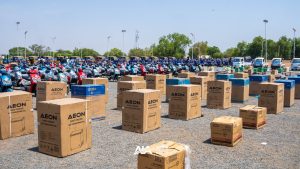
And as the dust settled at Mahmoud Ribadu Square, one thing was clear: this was not just an event. It was the beginning of many new journeys.